Keeping Track of a Game by Hand with a Score Sheet
Keeping track of a game by hand with a score sheet helps you follow confirmed scoring events, check the running total and preserve a clear match record.
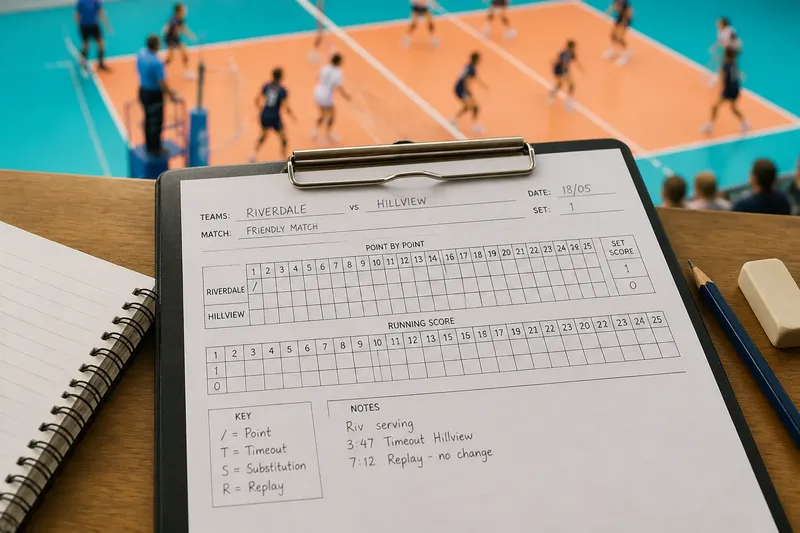
How do you keep track of a game by hand when the scoreboard shows only the current total? Keeping track of a game by hand starts with a score sheet that matches the sport and a habit of recording confirmed events, not guesses. Your notes can preserve the sequence behind the score without pretending to replace an official record.
Choose a score sheet
A cricket card, baseball scoresheet and volleyball scoresheet organise play differently. Look for spaces that match the game’s innings, periods, sets or rounds; a generic notebook is suitable for an informal game only if you decide what to record before play.
For a spectator’s record, focus on the score and the sequence that produced it. If the organiser requires an official score, use the prescribed form and notation instead of adapting a personal sheet.
- Check the sport and competition printed on the form; if they match, use it, and if not, find the correct form or draw a clearly labelled grid for informal use.
- Check that there is a space for each relevant period, innings, set or round; if any are missing, add labelled sections before play or choose another sheet.
- Check that the form has room for scoring events; if it does, reserve its boxes for those events, and if it does not, use a separate, labelled page.
- Check that you have a pencil, eraser and firm writing surface; if any are missing, gather them before play or choose a stable place where you can write.
- Check that team names and the fixture label are written in; if they are, begin recording, and if not, add them first to avoid mixing up sides.
- Check whether the organiser specifies official notation; if so, follow it, and if not, use a small key for any personal shorthand.
Prepare the layout
Write the teams or players in the spaces provided. Identify where the record begins and how it moves across the page, then trace that route with a finger if the printed layout is unfamiliar.
Choose a few legible marks and use them consistently. A short key in the margin can define personal abbreviations, but do not use private shorthand where it could be mistaken for official notation.
Check the rules and form to see when a score is recorded. Some sports award a point after a rally; others confirm a score after a phase of play. Follow the competition’s procedure where it applies.
Record confirmed events
Watch for the event that changes the score, then enter it after the call is confirmed. A whistle, appeal or pause can mean the result is still unsettled, so wait rather than writing down your first impression.
Keep entries brief and in the right box. If a detail is uncertain, leave the space blank or use a neutral mark that you can identify later; do not fill the gap with a guess. Keep observations such as a timeout in the margin, separate from the official score entries.
Say you are watching an informal volleyball match with a sheet that has one box for each point. The starting inputs are the two team names, a pencil, and a blank grid labelled for the set; suppose the first confirmed rally goes to the serving side. Mark that team’s box and update the set total, then compare it with the displayed score. If the referee pauses before confirming the rally, leave the box empty until the call; the resulting record reflects the confirmed point, while the trade-off is that a brief delay may leave you catching up during the next pause.
Check the running score
After a scoring event, compare your running total with the officials’ display. If the numbers differ, check the confirmed call, the team you marked and whether play has moved into a new period or set before changing anything.
At a natural pause, find the last completed entry, read the totals and compare them with the display. If there is a discrepancy, locate the first point where the records diverge and correct only what the official call establishes; do not erase a whole sequence because one total looks wrong.
Some sports display several kinds of score at once, such as a game score, set score and match score. Use the labels on the form and update the level that changed, rather than adding figures to an unrelated box.
Questions about score sheets?
How is a score sheet different from a scoreboard?
A scoreboard usually shows the current score in compact form. A score sheet can preserve the scoring sequence and provide room for periods or other relevant notes.
Should I use official scoring symbols?
Use official notation if the organiser requires it or you are keeping the official record. For personal viewing, define any shorthand clearly and do not present it as an official method.
What if I miss a play?
Leave the uncertain entry blank and wait for a reliable cue, such as the confirmed score or the next clearly marked phase. If you cannot establish what happened, note the gap rather than guessing.
Can my notes settle a disputed call?
A spectator’s sheet records what you observed; it does not replace the referee’s decision or the competition’s official record. Keep your observation separate from the ruling when discussing the match.
Close the record
At the end of a period, set or game, complete its total before moving to the next section. At full time, compare your final score with the confirmed result; if they differ, mark the discrepancy and avoid changing earlier entries until you can identify where it began.
Add a brief margin note if an entry remains uncertain or the game’s sequence needs clarification. Keep corrections legible, and follow the organiser’s process if the sheet is being handed in.
Keeping track of a game by hand works best when the record stays modest and readable. Treat each box like a labelled drawer: put one kind of information in the space intended for it. A score sheet makes it easier to see how the game reached its current score, while the official call remains the authority on the result.