The One-Position Player Myth: Why Roles Change During a Match
The one-position player myth misses how football roles shift with possession, pressure and team shape. Learn what to watch beyond a player’s starting spot.
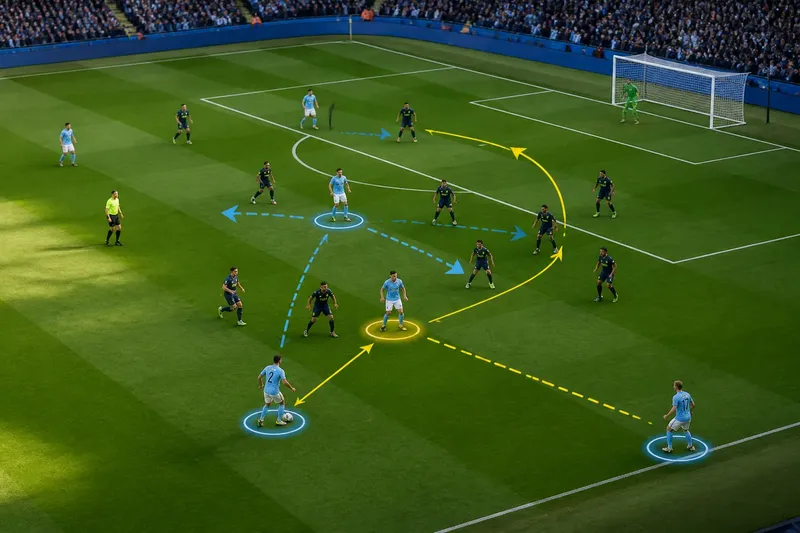
Why is the player listed as a defender suddenly receiving the ball near the opposition’s penalty area? The one-position player myth treats a football position as a permanent job, but players often take on different roles as possession changes and teammates move around them. To read those changes, watch what a player is responsible for in each phase, not only where they began.
What a position tells you
A position is a useful starting label: centre-back, full-back, midfielder or forward gives you a rough idea of a player’s usual area and duties. It does not describe every action they will take. A team’s formation, the opponent’s pressure and the location of the ball can all alter those duties.
It helps to separate a player’s position from their role. A right-back may defend the right channel, move into midfield when their team has the ball, then recover to the flank when possession is lost. The player has not changed position on the team sheet; the team has changed the job required of them.
Why roles shift
Teams need to solve different problems in different phases. When building from the back, they may want an extra passing option near midfield. When defending, they may need to protect the space behind a full-back. When attacking near the goal, they may want more players in the penalty area or someone positioned to collect a clearance.
Those aims shape movement. A wide defender can step inside to help circulate the ball, while a midfielder covers the space left open. A forward can drop towards the ball to connect passes, leaving a teammate to run beyond the defence. Each move affects the others; a role shift is often a coordinated adjustment rather than a player roaming without a plan.
Watch for the trigger. A role might change when the team wins the ball, when an opponent presses a centre-back, or when possession reaches a particular flank. The same player may then return to their usual defensive area once the immediate problem has passed.
How possession changes jobs
When a team has the ball, its players need to create passing angles, stretch the opposition and protect against a counter-attack. A defender might carry the ball forward or provide width; a midfielder might stay deep to guard against a turnover. A forward might drift wide to open a central lane for a runner.
When possession is lost, those choices acquire defensive consequences. The player who advanced may press the nearest opponent or sprint back, while a teammate moves across to cover the open space. A forward who had dropped deep may become the first line of pressure. The team’s shape can change quickly even though every player remains in the same starting position on the team sheet.
To follow the shift, track one player across the change of possession. Note where they are when their team attacks, what they do immediately after losing the ball, and where they settle once the opponents have established possession. This makes the role easier to recognise than watching only the player’s touches.
What team shape changes
A formation describes how a team is organised, but the arrangement can look different in attack and defence. A side that defends with four players across the back might have a full-back step into midfield during possession. The centre-backs can spread wider, or a midfielder can drop between them, depending on the plan.
That movement creates temporary responsibilities. If a full-back moves inside, someone may need to occupy the outside lane. If a centre-back carries the ball forward, a midfielder might cover the space behind. Look at the gaps as well as the players: the position one teammate leaves is often the clue to another teammate’s new job.
Shape also changes according to the ball’s location. A team may shift towards one side to press or defend, with players on the far side narrowing in. A winger who appears to be standing in a fixed wide role may therefore move inside without the team changing its basic formation.
Clues that reveal a role change
Start with a player’s movement relative to teammates. If a defender repeatedly enters midfield while another player drops into the defensive line, those paired movements suggest an organised rotation. A single forward run, by contrast, may be an attempt to exploit a moment rather than a lasting change in responsibility.
Then check what happens in the next phase. Does the player return to their starting area when the team loses the ball? Does a teammate cover the space they left? Does the movement recur when the same build-up pattern begins? Repeated, linked movements are stronger clues than a player’s location in one isolated moment.
Imagine a team whose right-back steps into the middle whenever its goalkeeper starts a short build-up. The right-sided midfielder stays wider, while the nearest centre-back shifts across to protect the channel. If that pattern appears again after a reset, a spectator can reasonably read it as a planned change of roles rather than a one-off wander.
Questions about changing roles?
Does a formation tell me every player’s role?
No. A formation shows a broad starting arrangement, not every responsibility in possession, defence and transition. Treat it as a map of the team’s general structure, then watch how players move as the ball changes sides or possession changes hands.
Can a player have more than one role?
Yes. A player might help build attacks from midfield, defend a wide channel after a turnover and arrive in the penalty area when a cross comes in. Those jobs can be connected parts of one tactical plan rather than separate positions.
How can I tell whether a movement is planned?
Look for a repeated cue and a teammate’s corresponding movement. If the same player steps into the same space during similar build-ups and someone else covers the vacated area, the pattern is more likely to be deliberate than an isolated run.
Why does the player’s listed position still matter?
It offers context about the player’s usual starting area and the duties they are commonly expected to fulfil. It becomes misleading only when treated as a complete description of everything they do during the match.
Read tasks beyond labels
The one-position player myth can make a match seem simpler than it is. A better question is: what problem is this player solving right now, and who is adjusting around them? Follow the movement across possession changes, notice who covers an empty lane, and compare repeated sequences. That gives you a clearer view of the team’s tactics than any single position name.
When a player appears out of place, pause before calling it a mistake. They may be filling a space another teammate has left, preparing for a transition or following the ball-side shift. The useful clue is what the rest of the team does next.