Your First Ice Hockey Match: Follow the Bench Changes
Follow ice hockey line changes with a clear viewing plan: spot who leaves, who replaces them and how each fresh arrival affects the next play.
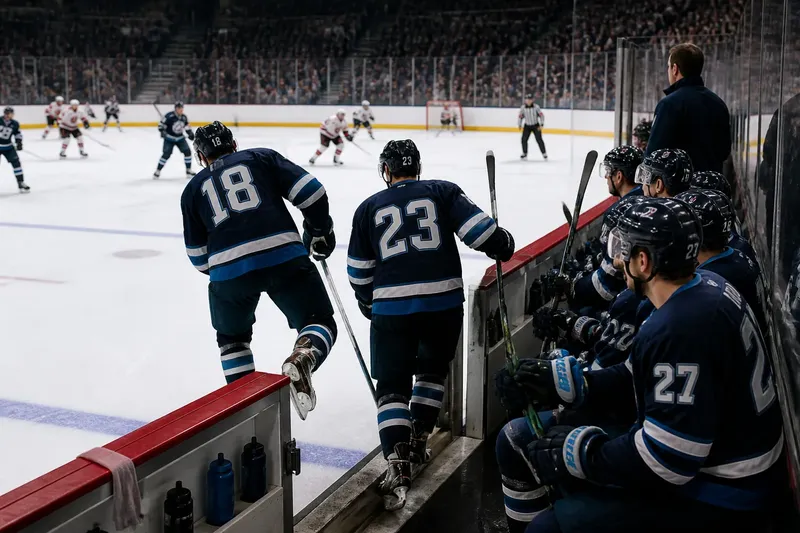
Who just left the ice, and who took their place? Ice hockey line changes give you a clear thread through a match, even when the puck moves too quickly to track every pass. Start by watching the players nearest one bench, then notice what the new group does next.
Players change while the game continues, so substitutions happen beside the boards as teammates come off and others step onto the ice. You do not need to memorise every player. For your first match, notice the change, the state of play around it and the response from the new group.
Before play
Choose a seat with a clear view of at least one team’s bench and the ice directly in front of it. If you can see both benches, useful; but keep a good view of the rink. Watch for players approaching the bench and the teammates ready to join play.
Teams commonly use forward lines and defensive pairings. A line is a group of forwards who often take shifts together; a defensive pairing is two defencemen who often share the ice. Coaches can change combinations, and a player may go out at a different moment from their usual group. Treat these as recurring patterns, not fixed units.
If a roster or arena display lists player numbers, use it as a reference rather than a test. Pick out the goalie and a few skaters with visible numbers. If names are hard to follow, track jersey colours and positions instead: noticing a winger leave and a fresh forward join is enough to spot a change.
First-period watching
For the opening stretch, follow one team’s bench. Look for a player gliding towards it while a teammate waits to join play. The departing skater usually reaches the boards and steps off as the replacement enters; the route and timing vary with the flow of play.
After a change, briefly check who came off, who replaced them and where the puck was. Then return your eyes to the play. This gives you a sense of the team’s rhythm without making you track every substitution.
Notice how a change begins. A player may head to the bench after the puck has moved away from their area, or teammates may take over during a longer attacking possession. The team must judge whether a skater can leave without giving the opposition an opening.
Say you see a forward circle towards the bench as their team sends the puck deep into the attacking end. A fresh forward joins as the original skater steps off, then moves towards the goal area. The observable result is a new skater joining the attack; what happens next depends on both teams’ responses.
Changes in transition
Once you can spot a change, watch what happens when possession shifts. A player who has just come on may be close to the action, while a skater on the other team may be trying to reach the bench. A quick counterattack can make the timing especially clear.
Do not assume that a player who looks tired must change immediately. The puck’s location, pressure from opponents and a safe route to the bench all affect when a skater can leave. Notice whether the team completes its change before the other side begins a rush, or whether someone stays on to avoid exposing open ice.
Ask whether the change leaves a teammate in a difficult position. If a skater heads off while the opposition advances, another player may need to cover space or delay the attack. You can connect the bench movement to the next defensive response without judging the coach’s decision.
Stoppages and face-offs
When play stops, you have a calmer chance to read the line-up. Look at the players gathering for the next face-off, where an official drops the puck between opposing players, and compare them with the group that had been on the ice. Teams often use the pause to organise their next group.
Watch the players nearest the face-off spot, then scan the other skaters. Which forwards are ready to support the play? Which defencemen are set farther back? If players adjust after the whistle, note the new arrangement without trying to infer a detailed instruction from one glance.
A familiar cluster may return for a restart, while a different combination can appear after a penalty, injury or unusual sequence. Bench patterns can shift, so do not assume a group you saw earlier will always return together.
Questions about line changes?
How often do hockey players change?
Players change repeatedly during open play, often after a short shift, but no single interval applies to every player or situation. The puck’s location, the pace of the game and the coach’s choices all affect when someone comes off.
Can players change during live play?
Yes. Teams can substitute at the bench while play continues, with one player leaving as a teammate joins. The exact conditions for a legal change depend on the competition’s rules, so consult its rulebook for precise details.
What is a line change?
A line change is the replacement of players during play or at a stoppage, often involving forwards and sometimes a defensive pairing. The phrase can describe a whole group switching or only part of it changing.
Why do teams change players quickly?
Skating hard, turning, checking and chasing the puck demand effort, so fresh players can take over while the match continues. A coach may also use a particular combination for the situation.
Later-period patterns
Keep following the same bench, but compare when the team changes: does it seem more ready to substitute with the puck in the attacking end, or when play is closer to its own goal? Treat what you see as a pattern in that match, not a rule that applies to every team.
Try following one player rather than a whole line. Watch the skater leave, then follow the replacement briefly: where do they position themselves, and do they join a rush, support a teammate or protect the middle of the ice? This gives the bench movement a tactical consequence you can see without knowing the coach’s plan.
If the arena display shows penalties, notice how a power play or penalty kill affects the players on the ice. A power play is a temporary numerical advantage after an opponent’s penalty; a penalty kill is the defending team’s effort while short-handed. Compare the group with the one used during ordinary play.
As the match reaches its final period, keep the same thread: who leaves, who comes on and what the situation asks of them. If the score is close, you may see familiar players return more often. An icing stoppage may also affect which players are on the ice for the next face-off, depending on the competition’s rules and the circumstances. Check that competition’s rulebook for the exact conditions rather than relying on a simplified definition.
Late in a game, a goalie may leave the net so an extra skater can join the attack. Look for the goalie heading towards the bench while a skater comes on, then watch how the team tries to protect its own goal while pressing forward. The team has traded the goalie’s presence for another attacking option, so the opposition may look for a shot towards the empty net.
If you lose track of a group, reset at the next stoppage. Identify the skaters at the face-off, locate the bench again and resume watching one team. A viewing plan should make the match easier to follow, not turn every change into homework.
A match-long routine
Use this sequence at the rink or while watching a broadcast:
Before play, choose one bench and note the team’s colours and a few visible player numbers.
During open play, spot a skater heading off and a teammate entering, then return your attention to the puck.
At a safe moment, note whether the change happened in attack, defence or a neutral part of the ice.
At a whistle or face-off, compare the players ready to restart with the group you last noticed.
When possession turns, check whether a departing player leaves a teammate covering space or whether the fresh arrival supports a counterattack.
In the final period, look for altered choices, such as familiar players returning or a goalie leaving for an extra skater.
For a quick observation checklist, use each sighting to make a decision:
If you can see one bench clearly, follow that team; if not, choose the bench with the clearest view from your seat.
If a skater heads towards the bench and a teammate enters, mark it as a change; if you cannot see the exchange, wait for the next clear one.
If the puck is in the attacking end during the change, note an attacking substitution; if it is nearer the team’s goal, note a defensive situation instead.
If play continues, return your attention to the puck after recording the exchange; if a whistle stops play, use the pause to scan the players preparing for the restart.
If a new skater joins a rush or supports the attack, follow their position briefly; if they stay back, watch how they protect space.
If a goalie leaves and a skater joins, watch the team’s defensive shape as well as its attack; if the goalie remains, continue tracking ordinary line changes.
Following ice hockey line changes is about seeing how a team manages effort while play keeps moving: who steps off, who takes over and what the fresh arrival lets the team attempt next. When you lose the thread, return to the nearest bench and wait for the next clear exchange rather than trying to reconstruct every substitution.